Dawn of Destruction: or, the Disneyfication of remembrance

Planning permission for Norman Foster’s crass, sprawling and arbitrary scheme for the Queen Elizabeth Memorial was quietly granted last month, a fortnight before major changes to the published designs were revealed. As a result, even more objects with varying degrees of relevance but a shared level of kitsch will be strewn across a gratuitously large swathe of St James’s Park, turning it into a commemorative theme park. What did it – and we – do to deserve this?

The Foster farrago was bad enough already, from the hideous bridge whose bellying balustrades of glass are apparently inspired by a tiara to the aggressive explosion of a sculpture meant to symbolise the wind. Now we must brace ourselves for a ‘Commonwealth compass’ resembling a giant half-eaten biscuit, plus several large stone benches shaped like boomerangs. The two statues have been altered and will be accompanied by a bust, the trio conjuring the unwelcome image of a Royal cruet set. Quite why this number of items is deemed necessary remains unclear, though a small display in the British Museum’s reading room for the next month offers a hint. It also reveals the full horror of at least one of those individual elements.


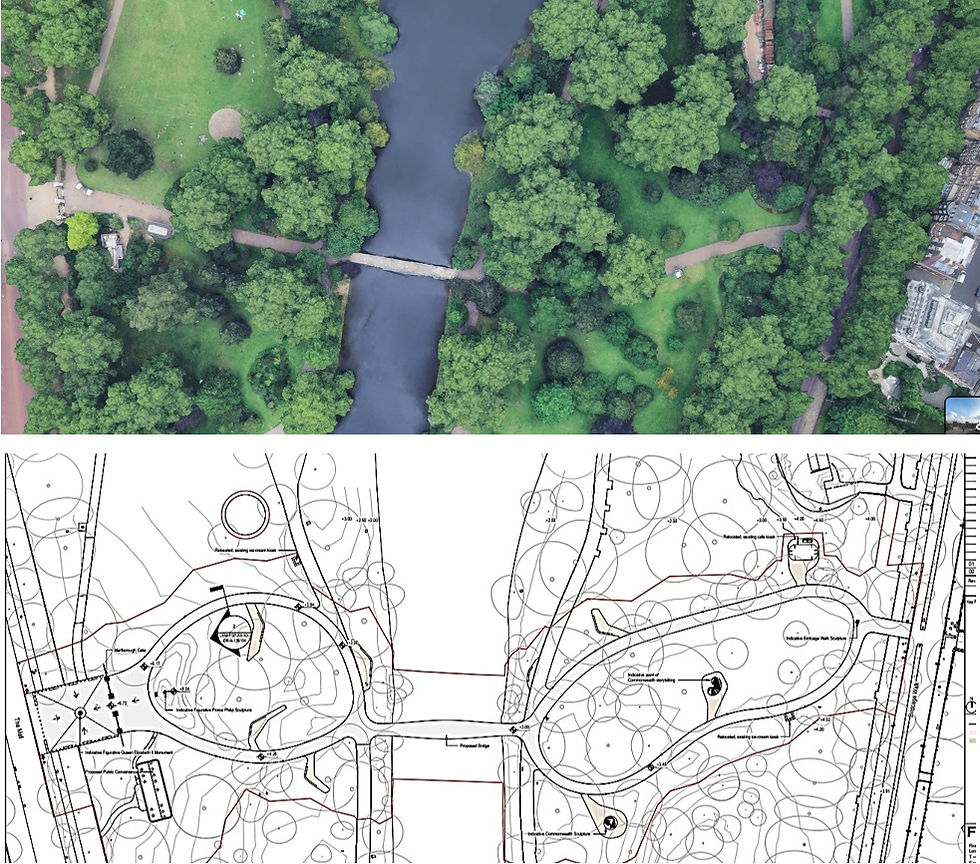
A topographical model of the overall scheme shows just how significant its impact on the park will be, although the carefully reproduced trees disguise some of this. Stretching from the Mall down to Birdcage Walk, a looping network of paths far more extensive than the current linear route will contain the various statues, sculptures, pillars, seats and so on. The new, much larger bridge will dominate the centre and the lake. But several of the existing refreshment kiosks will be moved and it appears that others may be added; the grass, flower beds and planting will of course also be torn up for all of this.

Maquettes of the statues by Martin Jennings raise few alarms, in fairness – conventional, uninteresting, they will offend no-one although having Prince Phillip look up at his wife – perched, as she will be, atop a column – feels awkward. But the same cannot be said of Yinka Shonibare’s truly bizarre Commonwealth Wind Sculpture. Said to be inspired by the Queen’s coronation dress, in fact it resembles nothing so much as an alien seed pod, both before and after expelling its unpleasant contents – so less a wind sculpture and more of a fart.
As for that hint, it is surely found in the painstakingly box-ticking text panel telling us that the memorial “embraces tradition, modernity, public duty, private faith, the United Kingdon, Her late Majesty’s Realms, and the Commonwealth” (and the many commonwealths of the former colony across the Atlantic, perhaps, if that Oxford comma is any indication). Phew.
Bafflingly, Foster’s was the ‘winning’ entry in last year’s competition to implement the disastrously misconceived memorial, and I’ve only not posted about that decision because I (and others) have been trying to fight it elsewhere. That has proven frustrating, beginning with the Memorial Committee itself.
It has refused to explain why St James’s Park was chosen when Green Park not only satisfies all of the stated criteria but has extra advantages, which is worrying when all are demanding better transparency in government. There have also been inconsistencies in the responses that have been provided, such as claiming that the former was chosen because the King Edward VI and Queen Mother memorials are nearby but then stating a few weeks later that the same park is not "in very close proximity to other memorials and statues".
Half a dozen amenity groups who might be expected to have a view appear to lack interest. The Gardens Trust has "followed the evolution of this project and reviewed the original short list” but referred to their role as a statutory consultee and said they would “make an assessment and advise the local authority accordingly." Historic England advised that “we wouldn’t comment on this as we don’t have a role here”, the Open Spaces Society “has no view” and the CPRE told me it is "currently dealing with a high volume of Green Belt related casework” and so they “don’t think we’ll have the time to get too involved in this.” When pushed they merely thanked me “for bringing it to our attention”, saying that “it’s always helpful to know these sort of schemes that may impact London’s parks and green spaces." One person who seemed to be across all groups said – in terms – that the scheme is a small change that addresses various actual issues, and doubted anyone will complain.
A depressing state of affairs, then, with seemingly nobody able or willing to stop this terrible scheme from contaminating central London’s prettiest park. And it has an ugly coda.

Shockingly, the delightful hand-wrought metal finials atop each stanchion of the existing Blue Bridge, featuring flowers in a nod to the surroundings and little crowns in reference to the Queen’s then-recent Coronation, have been vandalised on three separate occasions this year and have had to be removed. The Royal Parks told me the police have been unable to track down the culprit, and the remains of the lamps – which were “damage[d] beyond repair” and thrown into the lake – are now in storage while they evaluate the situation.
I found this news quite upsetting, though took a crumb of hope from the closing line of the last reply I received: “it would not be economical to have them recast if they do not feature in the design for the memorial, [but] we are still in talks with Foster & Partners with regards to the memorial including the new bridge and how it will look.” Fingers crossed.
It’ll be some time before what I’ll call the Day of Destruction – when spades hit soil and the birds fly away, maybe never to return – but I’ll keep across this, and hope that some common sense prevails. If not, don’t say I didn’t warn you.
The Queen Elizabeth Memorial display will be in the British Museum’s reading room until 21 June 2026.


Comments