The Painted Screen
Finding artists’ pictures in the look of television productions
Taboo (2017)
The original period drama Taboo was created by Steven Knight, its lead actor Tom Hardy and the latter’s father, Edward ‘Chips’ Hardy and was first screened on the BBC in 2017. Set almost two hundred years earlier, it follows the surprise appearance in London of James Keziah Delaney, a man who has been living in British Columbia for years, is regarded as a savage thanks to his mixed heritage and was assumed to be dead. As war with the United States of America continues and private companies demonstrate rampant aggression at home and abroad, the vital foreign trading post that Delaney has inherited prompts direct action by the government and the East India Company, yet the mysterious revenant is by no means helpless in response.
The series embraces Georgian-era geopolitics, the horrors of the slave trade, mercenary capitalism and anxieties over societal status, with bloody vengeance on every party’s agenda. The younger Hardy had the initial idea with the older Hardy, a writer in many genres, initially uncertain before embracing the concept and taking time to “build context and themes around [Tom’s] character brief.” It soon became obvious, Chips continued, “that the arena and the title should be Taboo.”
As an actor Tom was quoted at the time as having always hoped to essay “every classical character in one”. He would, he said, like to play more Bill Sykes, but as a lead. "But then I also thought I'd really like to play Doctor Faustus in Bill Sykes's body. And I'd also actually really like to play Hannibal Lecter there too. And Sherlock Holmes. And I think we should put Heathcliff in there too and Marlow from Heart of Darkness, we shouldn't forget him. And a little bit of Mr Darcy but not too much, because that's really boring, actually.”
The boiling yet controlled figure that develops from the writing of the father and the performance of the son is a kind of elemental force, unwavering in the search for answers about the death of his own father and as ruthless in his desire to retain his prize as his enemies are in trying to obtain it. Indeed, emanating as he does from a distant, mysterious land, travelling a great distance and appearing in the heart of London amidst rumours of supernatural powers and unnatural love, one might add Count Dracula to that heady – ‘Hardy’? – mix the actor described.
Impressive support is lent by what at the time was a mix of established and emerging talent, ranging from Jonathan Pryce as the perpetually angry Chairman of the East India Company through the gnarly loyalty of David Hayman as Delaney’s father’s servant to the edgy fervour of Tom Hollander as a chemist as unstable as the explosive he manufactures. The spirited enthusiasm of Jesse Buckley as Delaney Snr’s widow, an actress, and extraordinary inhabitation of the role of Prince Regent by Mark Gattis are additional treasures.
But it is the exceptional richness of the milieu these characters – and we – encounter that is the focus of this piece. The streets, quays and byways that Delaney prowls, the buildings both humble and lavish that he inhabits and the things people wear, touch and use give Taboo immense visual weight. Fully integrating costumes, set dressing, locations and cinematography, it is complete, convincing and absorbing.
Starting with those buildings, it’s worth noting the old observation that it often takes an outsider to reveal a place as it really is, so it may not be a coincidence that the series’ two directors, Kristoffer Nyholm and Anders Engström, are Danish and Finnish respectively.
The great houses of Hatfield in Hertfordshire and Ham House in Richmond, along with the pavilion-like Danson House in Bexley, were amongst the domestic sites providing exteriors and interiors. The main frontage of Goldsmiths’ Hall in the City of London, home of the ancient livery company whose assaying of the precious metal suggested by its name gave rise to the term ‘hallmark’, plays the headquarters of the East India Company and Tilbury and Coalhouse Forts much further east were used to atmospherically conjure the capital’s then-thriving docks. Less well known and particularly effective is the elegant 37 Stepney Green Gardens, used for the Delaney house. Important enough to have its own sizeable entry in the famous Pevsner architectural guidebook, it was actually built (in 1694) by a London merchant with overseas trade connections and later occupied – astonishingly coincidentally – by the widow of an East India governor. Its slightly raised entrance, pretty railings and narrow cobbled street are all visible in the series.
When it comes to the way in which these places were photographed, as well as the more detailed design elements that were layered in below them, it is impossible not to believe that specific scenes and shots were informed by the careful examination and deliberate selection of certain English paintings from the approximate period of the narrative as artistic inspiration. The use of light and shadow, the characters’ sumptuous clothing, the considered placement of props and even the exact positioning of people and things within the frame appear to have been employed to replicate the works of art I have set out, which are shown with screenshots from Taboo on the left in each case.
This aside, Mark Patten’s cinematography won the British Society of Cinematographers award for Best Cinematography in a Television Drama and Joanna Eatwell’s costume design won an RTS Craft & Design award, whilst Chips Hardy earned the Writer’s Guild of Great Britain award for Best Long Form TV Drama in 2018. Fittingly, a recent rewatch confirmed the power and presence of the series and showed just why those awards were given.
_____________________________________________________
Posted October 2026

Delaney awaits the reading of his father’s will, a point of stillness amidst a chaotic crowd of angry creditors. His pose, hat, gloves and clothes immediately recall those of Thomas Lister, 4th Baron Ribblesdale, in John Singer Sargent’s 1902 portrait, with the picture frame behind Delaney echoing the pilaster behind Ribblesdale.

A lively brothel scene, with gilt screens, elaborate candelabras and powdered wigs, parallels The Tavern Scene by William Hogarth (1735), part of his allegorical series A Rake's Progress. The setting is a combined brothel and restaurant and whilst Tom Rakewell, his foot casually on the table, unknowingly begins his decline, Delaney’s future is far more assured.

Delaney often walks the Thames foreshore, where waifs and strays, some friends and underworld contacts, work and live. Shots like this are reminiscent of William Dyce’s Pegwell Bay, Kent – a Recollection of October 5th 1858, painted in 1860. Shrimpers and shell pickers bend to their tasks by the breakwaters as Donati’s Comet soars overhead.

Ibbotson, Delaney's tenant farmer, ponders one night by the fire. A bottle is before him, backlit by the flames; in a niche high up in the wall, a cross is illuminated by candles. The effect is remarkably similar to An Iron Forge (1772) by Joseph Wright of Derby. One of his ‘night-pieces’, it treats an everyday task as heroic.
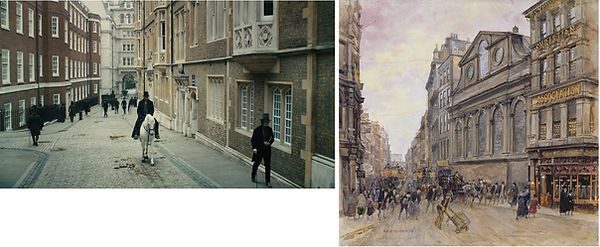
Delaney rides through the streets of London to an appointment, the road tightly flanked by – and our view almost entirely filled with – buildings. Topographic artist Henry Edward Tidmarsh recorded many scenes like this, here showing St Peter’s Cornhill on Gracechurch Street from 1900. There is little sky and the figures (known as staffage) are hunched.

A wagon passes through a dockyard gate, guarded by an old ship’s figurehead of sea god Poseidon (the Roman Neptune). The shot is clearly inspired by the photograph of the entrance to Castle's Ship Breaking Yard on Millbank, Westminster, taken in 1909.

The sun sets over the Port of London, with St Paul’s and a bridge – possibly Blackfriars – in the foreground. It is a stylised image, but so is Canaletto’s The River Thames with St. Paul's Cathedral on Lord Mayor's Day, which he painted in 1746-47. The Italian’s picture is brighter and more optimistic than Knight’s.

A boat is rowed away from a ship, as the moon shines its silvery light down onto the water. John Atkinson Grimshaw is famous for his nighttime and autumnal depictions of English towns; this is Southwark Bridge by Moonlight (or sometimes The Thames by Moonlight with Southwark Bridge) from the 1880s.