Politically correct

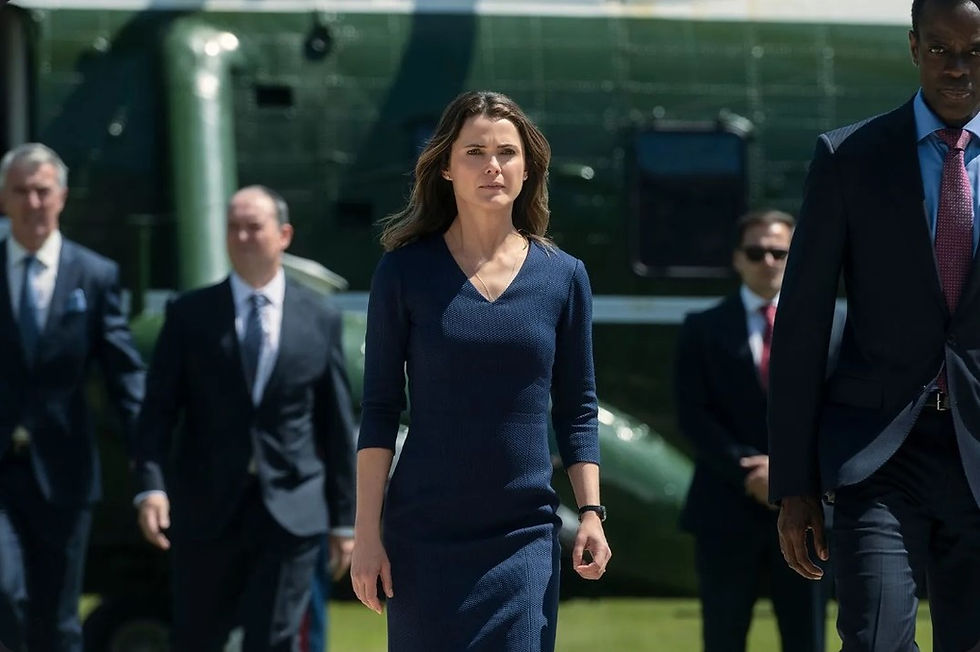
As I’ve recently discovered, there are many reasons for devouring the superb Netflix series The Diplomat, created by Debora Cahn. The exceptional performance of Keri Russell in the title role, and Rory Kinnear’s outstanding support as the British Prime Minister; the brutal, brittle relationships between them and Rufus Sewell (also good) as her husband; the agonising geo-political dilemmas that entwine them all and feel disturbingly real. But there is also the drama’s unprecedented access to the actual government buildings featured in the narrative, the real locations where politics happen.
I’ve written before about the powerful effect generated by filming inside some of the most famous or secure buildings in the world rather using stand-ins, even if those illusions – achieved by the industry’s location scouts, primarily – can sometimes reach remarkable heights. You can read more about that skill in ‘Day for Night’, another of my Beyond the Frame pieces, whilst in the television world I really enjoyed the Royal College of Physicians playing the ‘Dutch Embassy’ in the BBC’s Silent Witness many years ago (the episode is live at the time of this post; you only need to watch the first five minutes).
Of course the challenges presented by this level of authenticity are manifold and you might like to think about some of them yourself whilst admiring the results, as here I’m simply celebrating what the team at Netflix have done across the programme’s three seasons to date.

The principal coup is filming in the grounds of, immediately outside and within the US Chancellery in London. Designed by KieranTimberlake architects and opened eight years ago this month, the new building in Nine Elms, Wandsworth, a former industrial zone, represented a major geographical, social and practical shift after forty-odd years in Grosvenor Square, Mayfair.

A billion-dollar cube of steel, glass and ethylene tetrafluoroethylene ‘shells’, it sits within its own compact gardens that are irrigated by a curved pond which many refer to as a moat.
In The Diplomat it’s the office for ambassador Kate Wyler and other key characters, and they are often seen arriving. Filming captures cars pulling up in front of the distinctive tapered columns, having used the tunnel that brings them under the building from the public road. Inside, Wyler debates the most suitable space to hold a commemorative event during one episode, pondering the possibly inappropriate message sent by a vast wall-mounted relief of the Great Seal in the lobby. It is genuinely remarkable that this use of the building was allowed, especially given the events of the series as they unfold; almost as remarkable as the sly depiction of it being possible to land a helicopter on the roof (it isn’t).

Britain doesn’t have an embassy in its capital, of course, but the equivalent for the story is the Foreign, Commonwealth and Development Office overlooking St James’s Park and Downing Street. This vast block was finished in 1875 to designs by George Gilbert Scott and Matthew Digby Wyatt. Controversially Classical at a time when Gothic was dominant, the building was intended for the Foreign, India, Colonial and Home offices. Each façade is slightly different as a result, and is decorated with appropriate statuary. Each also had its own internal courtyard.

It is the famously stupendous interiors that feature in the programme, however, as Wyler and foreign secretary Austin Dennison (David Gyasi, magnetic) meet, flirt and work. The suite of rooms built for the Foreign Office at the eastern end of the site, now named after the Locarno Treaties, is served by a magnificent Roman-style staircase. Appearing regularly in the programme are many of the large halls that open off of it; lined with immense murals and lavish decoration in an almost overwhelming manner, that the series’ directors often shoot them from the lowest possible angle and with a very wide lens is revealing. The courtyard of Wyatt’s India Office was glazed over and re-floored just after the building was completed. One of the most spectacular Victorian spaces in the capital, it is now called the Durbar Court and the makers use it for an almost Hitchcockian scene involving a dropped item that proves vital.

Diplomacy involves global travel, of course, and public buildings of a different if equally impressive kind are often the destination in the programme. The Musée du Louvre is undoubtedly better known to international audiences than the many Parisian palaces that house the executive and legislative branches of the French government, but it is also well- suited to diplomatic events. It is thus no surprise to see it appear.

Architect I.M. Pei’s controversial if by now generally accepted steel and glass pyramid is the introduction to an extended sequence in which Wyler meets French representatives. As she descends the elegant stainless steel stair into the underground Napoleon Hall the camera follows, as does Dennison, with his and her relationship developing. Fittingly for a scene about king-making, the climactic encounter takes place before David’s gigantic painting Le Sacre de Napoléon, depicting Bonaparte’s coronation at Notre-Dame de Paris.

Throughout, it is hard to know which is the more ravishingly shot – the Louvre, with its exquisite creamy concrete, or Russell, in a dress by costume designer Roland Sanchez based on a Galvan original.
It is a sign of just how impactful these choices are that other spectacular locations featured in the series, also playing themselves, feel ordinary. The production closed St Paul's Cathedral for four full days for a service to be staged (“Not even The Queen” did that, boasted supervising location manager EJ Richards), whilst the Old Royal Naval College in Greenwich also shared the limelight. Out of town, Blenheim Palace took a break from pretending to be in Italy (in the Bond film Spectre) or France (Ridley Scott’s Napoleon) to play itself, the Duke of Marlborough’s Oxfordshire seat of 1722 as designed by John Vanbrugh in martial, masculine style.

That sleight of hand I described at the beginning is still encountered in The Diplomat – it would be impossible to make otherwise. But even this is handled with aplomb. The United States Ambassador to the Court of St James’s, to give that post its full title, does not live in the building where most ambassadorial business is conducted, which is why that country has a Chancellery and not an Embassy. Winfield House, in Regent’s Park, was built in 1936 by architects Wimperis, Simpson and Guthrie for Woolworth heiress Barbara Hutton. She donated it to the US government after the war, and it was first used as the ambassadorial residence in 1955. Filming there – even in its garden, famously the second-largest in London after that of Buckingham Palace – was a step too far for Netflix, which turned instead to Wrotham Park. Despite being named after a village in Kent, the house is in Hertfordshire. It sits high on a hill rather than on flat ground and is of a different style than Winfield House, but careful framing and the wonders of digital compositing (when you watch the show, note the BT tower aglow on the skyline) make it work. The house is also open to the public, and worth a visit.
Diplomacy is a skill practised by all of us from time to time. We perform it wherever we have to, and few would quibble if a film of our lives got that wrong. At the scale of The Diplomat, though, the stakes are higher both on and off the screen, so it’s reassuring to find a series that gets it correct.
Season 4 of The Diplomat is expected to premiere on Netflix in late 2026 and a 5th has also been confirmed


du doan xsmb mình thấy bạn bè hay nhắc nên ghé thử cho biết, kiểu vào lướt cho vui thôi chứ mình cũng không phải dân soi cầu gì. Ấn tượng đầu là họ làm bài theo đúng ngày nhìn khá rõ, mình vừa vào đã thấy tiêu đề kiểu “Soi cầu MB ngày 16 8 2026” nên không bị lạc đang đọc ngày nào. Nội dung bên dưới chia thành mấy đoạn ngắn, tiêu đề nổi bật nên kéo xuống đọc nhanh, không bị một cục chữ dài khó chịu. Mình cũng thích cái cảm giác trang này sắp xếp gọn gàng, nhìn phát là biết chỗ nào là phần dự đoán cho đúng ngày đó. Nói chung lướt…
Mình chơi xổ số kiểu cho vui là chính, coi kết quả như một trò giải trí nên cũng không đặt nặng chuyện phải trúng to. Trước đây nghe người ta bàn về “cầu kèo” các kiểu mình thấy hơi mơ hồ, nửa tin nửa ngờ, nhưng lâu lâu theo dõi lại thấy có vài chỗ trùng hợp nên cũng tò mò. Có lúc mình lướt đọc mấy bài như https://soicauxsmb.io/nuoi-lo-bach-thu-khung-2-ngay.html rồi ghi lại vài ý ngắn, sau đó đem so với kết quả thực tế để tự kiểm tra xem mình có bị cuốn theo cảm giác không. Trúng được chút thì vui thật, nhưng cũng có ngày lệch hoàn toàn nên mình luôn nhắc bản thân đừng tin…